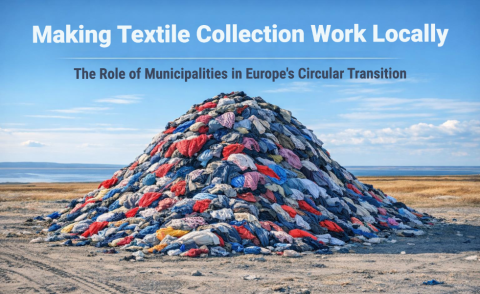
This workshop explores how cities and towns are implementing separate collection of used textiles, now required across the EU. Local leaders and experts from different regions will share how they organise services, engage citizens and businesses, and address costs and constraints. The state of play in Catalan municipalities, a Portuguese municipal experience in organising textile waste collection, the textile hub in Prato (Tuscany, Italy), and the Catalan Circular Fashion Pact will be presented. The workshop will also examine the challenges faced and the support needed to align EU goals with local action, highlighting regulatory gaps, funding needs and scalable solutions for municipalities.
- Circular economy | Local and regional | Sustainable
- Code: 14WS263931
- Square Brussels, Studio 314+316, Mont des Arts, Brussels, Belgium



Moderator

Practical information
- When
-
Wed 14/10/2026, 09:00 - 10:30 CET
- Where
- Square Brussels, Studio 314+316, Mont des Arts, Brussels, Belgium
- Type of partnership
- Partnership
- Format
- Workshop
- Theme
-
Strong regions, strong Europe
- Languages
- English, Spanish, Italian
Partners




Document
discussion_paper_textiles_workshopeurw
Reporting
Session summary
Key messages
• Producers must cover the full costs of textile waste management. Extended Producer Responsibility (EPR) schemes should finance collection, transport, sorting, reuse and recycling, in line with the polluter-pays principle, rather than leaving municipalities to bear the financial burden.
• Separate collection must be backed by adequate infrastructure. Investment in sorting, reuse and recycling capacity is essential to turn collection obligations into real environmental benefits, supported by EU, national and regional funding.
• Social economy organisations need support to remain viable. Charities and social enterprises combine textile collection and reuse with local job creation, social inclusion and training. Growing volumes of unusable textiles, declining second-hand revenues and rising sorting and disposal costs threaten their viability. Without appropriate support, Europe risks weakening a key pillar of its textile circular economy. Their contribution to textile collection, preparation for reuse and job creation should be reflected in future legislation and EPR schemes.
• The growing impact of ultra-fast fashion poses a structural challenge to textile collection systems. The rapid growth of ultra-fast fashion brings large volumes of low-cost garments onto the European market every year, often with short lifespans and poor durability. Their low resale value and difficult-to-recycle fibre compositions further limit their potential for reuse and recycling. Greater attention must be paid to product design, durability and consumption patterns.
• Local and regional authorities must have a formal role in governance. Municipalities should be involved in designing, implementing and monitoring EPR schemes, reflecting their responsibility for collection services and direct engagement with residents.
• Europe must move beyond collection towards market creation. Insufficient demand for recycled fibres, secondary textile raw materials and reusable textiles are a major barrier.
• Policy must address the entire textile value chain. Ecodesign, durability, consumer information, waste prevention, reuse and recycling measures need to work together to tackle the impacts of fast and ultra-fast fashion.
• Cooperation is essential to deliver circularity. Initiatives such as the Catalan Circular Fashion Pact and Prato’s textile ecosystem illustrate the value of cooperation between public authorities, industry, research organisations, social enterprises and civil society.
Overall message: Europe’s textile circularity ambitions require more than legislation: they need adequate funding, infrastructure and strong local implementation capacity. Their success will ultimately depend on delivery in cities and municipalities.
Quotes
-
We call for the extended producer responsibility system to be defined in the best possible way and as soon as possible, so that the costs of the entire collection, treatment and recycling cycle are covered
There is a high value recovery potential of textile materials and a big need for more efficient and circular solutions
The role of local administrations in textile waste management is crucial: we are the institutions closest to citizens and businesses, and it is at the local level that the transition towards a circular economy and reuse becomes an operational reality.
It is both necessary and urgent to transform the production and consumption model of the textile sector and move towards a more sustainable and regenerative circular model for the planet
Municipalities are facing a growing textile waste crisis, with far too few reuse and recycling solutions available.