
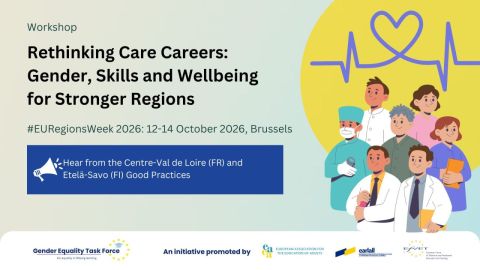
Across Europe, care sectors are facing increasing labour shortages, driven by demographic change and rising demand. These sectors remain highly gender-segregated and often struggle with attractiveness, workforce well-being, and their capacity to attract, retain and support people’s right to stay in regions. In this workshop, regional policymakers in France's Centre-Val-de Loire region will present training policies to raise awareness of gender-based violence in care settings. We will explore VET policies on well-being and inclusion, including inputs from a representative from Finland's Etelä-Savo region; EU standards from OSHA; and gender-sensitive good practices in adult learning.
- Education and culture | Health | Social inclusion and Equality
- Code: 14WS263859
- Square Brussels, Hall 400, Mont des Arts, Brussels, Belgium



Moderator
Practical information
- When
-
Wed 14/10/2026, 16:00 - 17:30 CET
- Where
- Square Brussels, Hall 400, Mont des Arts, Brussels, Belgium
- Type of partnership
- Partnership
- Format
- Workshop
- Theme
-
Strong regions, strong Europe
- Language
- English
Partners



Document
ewrc-2026--ge-tf-presentation-and-banner-(1
Reporting
Session summary
Opening and moderating the session, Gina Ebner, Head of Policy and Deputy Secretary General at EAEA, invited participants to consider how education and training can address the interconnected challenges of gender inequality, workforce shortages and mental health in care.
Csaba Borboly, Member of the European Committee of the Regions and Vice-President of Harghita County Council, Romania, highlighted the difficulties regions face in attracting young people to care careers. Pay often fails to reflect the responsibilities involved, undermining both the attractiveness of the profession and the sustainability of regional services.
He stressed that employers should provide training and give workers sufficient time to participate. However, training alone cannot resolve poor working conditions. Career guidance and learning opportunities must also be accessible where people live, including in less-developed regions.
Borboly outlined four recommendations:
1. Every region should create a permanent skills partnership of local authorities, care providers, VET schools, universities, employment services, workers, social partners and civil society.
2. Regions facing demographic decline or shortages need targeted, long-term technical support and stable funding, not short projects.
3. Better training must grow together with better jobs: fair pay, enough colleagues, safe conditions and respect. Skills policy and employment policy must work together.
4. Measure real results: completion rates, quality jobs found, retention in the sector, improvement in wages and conditions, and whether rural communities keep essential services.
His contribution underlined the need to plan skills and employment policies together, with civil society, employers and care professionals involved in shaping responses that fit their communities.
Violaine Roggeri, Communications Officer at the European Agency for Safety and Health at Work (EU-OSHA), presented the agency’s approach to preventing psychosocial risks. She introduced the 2026–2028 Healthy Workplaces Campaign, “Together for mental health at work”, which promotes awareness and prevention of work-related psychosocial risks.
Key figures quoted from recent EU surveys:
• 29% of European workers reported stress, depression or anxiety in the past 12 months caused or worsened by work.
• 4 in 10 workers report severe time pressure or work overload.
• Poor workplace mental health costs the EU about 600 billion euros a year.
• Each euro invested in effective measures can return up to 13 euros through lower absenteeism and turnover and higher productivity.
• Close to half of EU workers do not feel comfortable disclosing mental health issues, for fear of discrimination or blocked careers.
Recommendations.
• Take a preventive, participatory and holistic approach, building on the EU directive that makes risk assessment mandatory. Some countries (for example Belgium) already include psychosocial risks; others should follow.
• Address psychosocial risks at the root first; then act on their sources, involve workers so they feel safe to speak up, and train managers and team leaders.
• Individual measures such as a mindfulness course are useful but not enough on their own.
• Design mental health prevention with gender in mind.
• Use the campaign tools; health and care is a priority sector of the campaign.
A regional example came from Zoé Dedobbeleer Carlier, CIDFF Eure-et-Loir, the Centre for Information on Women’s and Families’ Rights, who presented an initiative from Centre-Val de Loire (EARLALL member region).
Implemented during 2025–2026, the initiative formed part of a regional strategy adopted in 2023. It responded to findings attributed to France’s National Order of Nurses in 2024, indicating that 49% of nurses had experienced gender-based or sexual violence at work.
The project brought together two organisations with complementary expertise: Planning Familial, founded in 1956, which works on sexuality education and sexual and reproductive rights, and the CIDFF network, established in 1972, which supports women’s access to rights.
• A 6-hour training for educational teams, so that staff can become points of contact in their institutions.
• A 3-hour awareness session for first-year health and social care students, co-designed by both organisations, covering gender stereotypes, domestic violence, coercive control and sexual violence.
• Results: 8 institutions, almost 1,000 students trained, average rating 4.58 out of 5. Students stressed the need to listen to, believe and guide victims without judgment.
• One institution built an entire day on the topic, with a forum of local organisations in the afternoon, showing institutional ownership.
• Some resistance came from both men and women, which confirms that this is a systemic issue, made more pressing by rising masculinist discourse.
Dedobbeleer described resistance encountered during the training, including attempts to minimise violence. This reinforced the importance of addressing its systemic nature and strengthening education in a context of growing masculinist discourse. The region plans to extend the initiative into 2026–2027.
Arja Flinkman, CEO and Chief Principal of Etelä-Savon Koulutus Oy / South Savo Education Ltd and EfVET VP for Policy, Research and Publications, presented approaches developed in Finland to improve the attractiveness of health and social care careers amid demographic change.
The region is losing inhabitants while the number of people over 80 is set to triple. Low pay is no longer seen as the main obstacle, because job roles were redesigned together with employers and trade unions: practical nurses who add small partial qualifications (micro-credentials) move to higher salary levels and take over some tasks from registered nurses, who in turn take over some from doctors. A regional project with a university of applied sciences, employers and authorities produced five outcomes:
1. Joint skills anticipation by education providers, employers and regional authorities.
2. Flexible work-based upskilling with short, targeted training alongside work.
3. Recognition of skills through competence passports and partial qualifications.
4. Clear career pathways linking continuing education to defined roles.
5. Openly shared learning resources (materials and videos), free for organisations outside the project.
A second initiative developed contract-based family care as a new entry route to the sector: targeted recruitment, preparatory training in ageing, dementia and safe care, predictable compensation, flexible short-term day and night care, and further education options.
Recommendations. Cooperate across silos; recognise prior learning; link training to career and pay progression; share resources openly; keep quality in practical nurse education. She noted that cooperation between higher education, VET and employers was difficult and only succeeded thanks to enthusiastic people.
Emilio Dogliani, Advocacy and Project Manager at EfVET, explored how vocational education and training can offer stronger career prospects in care.
He called for greater permeability between VET and higher education, enabling learners to move more easily between pathways and continue developing their careers. He also advocated updating the Council Recommendation on VET and including measurable targets for system integration in the forthcoming EU VET strategy.
Dogliani cited a perception gap: three in four EU citizens regard general education as more prestigious than vocational education. He argued that improving VET’s reputation requires investment in quality provision, guidance and visible opportunities for progression.
Gender segregation remains another challenge. While VET overall was described as male-dominated, care-related programmes remain predominantly female. An EU-wide guidance and counselling framework could help challenge stereotypes, encouraging girls to consider STEM and boys to explore care careers.
He also emphasised the importance of transversal competences, including critical thinking, a growth mindset and learning to learn. In care, these must be complemented by empathy, communication and compassion, developed through cooperation between education providers, families and the wider learning community.
Key challenges identified by the panel:
Raising awareness and building a safe environment where people can speak up; training managers and team leaders to address psychosocial risks. The health and care sector is the campaign's priority next year.
Making care work respected and sustainable: fair pay, safe working conditions, enough staff and real career opportunities, otherwise regions keep losing workers and young people.
Investing in VET provision for these sectors; otherwise care training will not reach the quality of other pathways and human potential is lost.
Wellbeing at work in the care sector, together with salary and working conditions.
Working in silos: all stakeholders must be listened to (education, nurses, practical nurses, doctors, patients, directors, investors and politicians), and budgets must not be cut, since underinvestment increases mental and physical health problems.
Cross-cutting challenges that also emerged:
• Low pay, heavy workloads and poor conditions, which education alone cannot fix.
• Violence, harassment and stigma around mental health, with under-reporting.
• A poor reputation of care work, linked by participants to its being a female-dominated sector.
• Workforce shortages and demographic change, especially in rural and depopulating regions.
• Limited permeability between VET and higher education, and weak guidance.
• Difficult cooperation between organisations with different cultures.
• Threats to EU funding for skills and social policy