Publication date: 20/10/2026
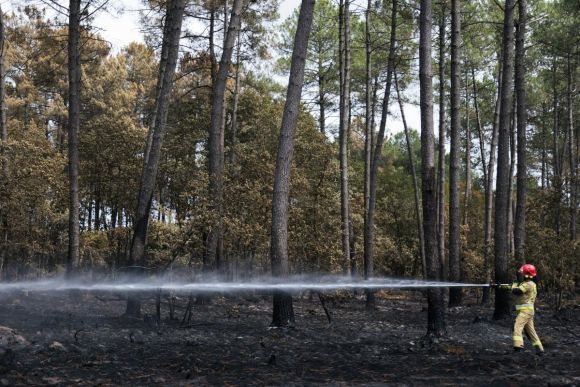
At the European Week of Regions and Cities, experts discussed how better use of data, stronger prevention and community involvement could help Europe tackle the growing threat of wildfires.
Fire no longer keeps the hours it once did. Emerging scientific evidence suggests that night, long the moment when flames settled and crews regrouped, no longer reliably slows a wildfire’s spread. That warning framed a workshop held in Brussels on 14 October during the European Week of Regions and Cities, organised by RES2FIRE, an Interreg IPA ADRION project uniting nine partners from seven countries. Its speakers circled one quiet paradox: Europe holds more wildfire data than ever, yet struggles to turn it into action.
From data to decisions
Konstantinos Panitsidis, an assistant professor at the University of Western Macedonia, presented tools already within reach, from Copernicus satellite services to machine learning, and showed hazard maps of the Greek municipality of Marathon. “The challenge is no longer only how to produce more data,” he said. “The challenge is how to transform the data we already have into decisions.” Angelo Marciano, a retired brigadier general of Italy’s Carabinieri Forestry Service, added that although the number of fires in Italy has fallen over five decades, megafires are growing, fuelled by abandoned farmland that allows vegetation to spread uninterrupted from mountain slopes to the edges of towns.
Communities on the frontline
That edge of the wildland-urban interface is a threshold in every possible sense. According to the organisers, around two-thirds of Mediterranean wildfires ignite there, and 95 to 97 per cent of Europe’s fires are caused by people. The same hands, however, can also protect. Goran Šoster, director of Slovenia’s Prlekija Development Agency, described a country of two million where almost every village has its own volunteer fire brigade and more than 160,000 people serve as volunteers. In his home region of Pomurje, about 20,000 volunteer firefighters and members serve roughly 110,000 inhabitants. Children start training at six or seven, advancing step by step through a system that keeps them out of situations they are not trained for. “In Slovenia, this is like football,” Šoster said. “You have to be there, because everybody is there.”
In Potenza, southern Italy, Giuseppe Brindisi outlined a more clearly defined role: volunteers spot fires, monitor risk areas and help residents evacuate, but never replace the fire service. Italy’s national campaign “Io non rischio” («I don’t take risks») seeks to turn citizens from mere recipients of alerts into people engaged in prevention.
Beyond emergency response
Goodwill alone cannot hold back a fire front. Marciano warned that spending cuts, staff reductions and fragmented responsibilities have left Italy’s system in a “seriously fragile condition”, and that heavy reliance on volunteers can itself signal that fragility. “I know only one way to put out a fire: reach it where it starts, as quickly as possible,” he said, calling for more trained operations directors, a shift from emergency response to long-term land management, and an EU-funded study into why fires are started.
Panitsidis proposed a lasting bridge between science and operations: jointly staffed teams or formal university partnerships that outlive individual projects. Europe’s 2025 wildfire season was its worst on record, with more than one million hectares burned. In March 2026, the European Commission launched a new approach to integrated wildfire risk management. Quoting a Scandinavian proverb, Marciano left the room with an image that lingers like smoke: “Fire is a good servant, but a bad master.”
By Sofija Zaiceva