How can integrated regional investments stop depopulation and make regions truly attractive for life and work? Drawing on the experience of Osijek-Baranja County in Croatia, a predominantly rural region facing demographic challenges, this EURegionsTalk presents a place-based approach that combines affordable housing, local economic development, healthcare, social services and education into a coherent regional strategy. The talk aims to inspire other regions facing similar challenges, spark a discussion on what cohesion policy can do better, and show that strong regions are built not by single investments, but by connected ones.
- Cohesion | Demographics (depopulation and ageing) | Investment and Finances | Local and regional | Rural | Social inclusion and Equality | Territorial | Youth and citizens engagement
- Code: 12TK264113
- Jacques Delors building, JDE 60, Rue Belliard 99/101, Brussels, Belgium
Speaker
Practical information
- When
-
Mon 12/10/2026, 17:30 - 18:00 CET
- Where
- Jacques Delors building, JDE 60, Rue Belliard 99/101, Brussels, Belgium
- Type of partnership
- Partnership
- Format
- EURegionsTalk
- Theme
-
Strong regions, strong Europe
- Language
- English


Reporting
Session summary
Osijek-Baranja County: Place-Based Investments for Stronger Regions
A place-based approach to regional development
Osijek-Baranja County in eastern Croatia has faced demographic decline and development challenges, but EU cohesion policy and national support have helped turn its potential into tangible investments. The County’s goal is not simply to build infrastructure, but to create the conditions for people to live, work and remain in their communities. This requires integrated action across jobs, healthcare, education, housing, transport, the environment and access to services.
Planning, partnerships and capacity
Since Croatia joined the EU, it has received €29.17 billion from the EU budget. Over the past decade, €5.54 billion in investments has been contracted across the five Slavonian counties, including €2.09 billion in Osijek-Baranja County. Successful delivery depends on strategic planning, well-prepared projects, capable regional institutions and coordinated funding—from cohesion policy and the Recovery and Resilience Facility to territorial cooperation and national and County resources. Since 2017, the Council for Slavonia, Baranja and Srijem has helped coordinate priorities between the five counties, the Government and other stakeholders.
Investments that respond to local needs
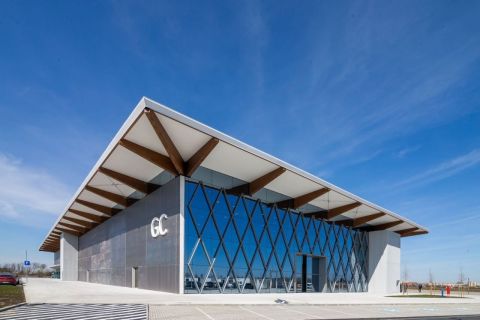
Key projects strengthen the regional economy and value chains. The €14.8 million Regional Distribution Centre for Fruit and Vegetables provides 3,200 tonnes of refrigerated storage and has reached full occupancy, helping producers reduce losses and sell beyond harvest season. The €9.5 million Economic Centre supports trade fairs, conferences and business meetings; it hosted 35 events in 2025. Investments in agriculture and milling aim to keep more value from local production within the region.
People, services and quality of life
Education investments include €74.5 million for the construction and reconstruction of 19 primary schools, expected to benefit 5,128 pupils, and a €16.3 million project at the First Gymnasium in Osijek. A planned €11.96 million investment at Vladimir Nazor Primary School in Đakovo will support children with special educational needs. The County’s €12 million housing programme aims to help young families through rent-to-own housing and direct support. The planned Clinical Hospital Centre Osijek, estimated at €850 million, would strengthen healthcare for a regional catchment area of more than 800,000 people.
Connectivity, environment and heritage
The €14.3 million modernisation of Osijek Airport is intended to improve mobility, tourism and investment appeal. The €6.1 million mosquito-control project, co-financed through the Hungary–Croatia Interreg programme, combines public health, environmental protection, research and cross-border cooperation. The planned €118.9 million Orlovnjak Regional Waste Management Centre will serve two counties. Other investments include energy renovation of the Museum of Fine Arts and the planned restoration of Prince Eugene of Savoy’s Castle in Bilje, showing how sustainability and cultural heritage can support regional development.
Key message
These projects demonstrate that demographic, economic, social and environmental challenges are interconnected. Strong regions are built not through isolated projects, but through integrated investments tailored to the needs and potential of each place. Cohesion policy, effective multilevel governance and capable local institutions are essential to improving quality of life and ensuring that less developed and border regions can remain attractive places to live, work and invest.