Publication date: 20/10/2026
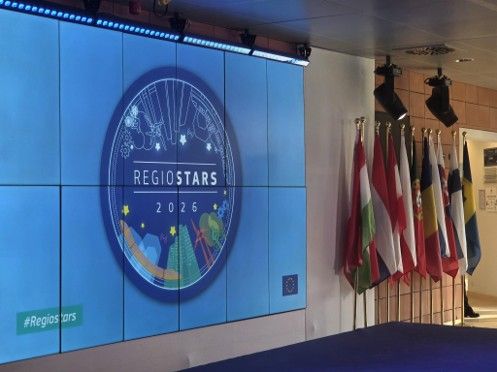
Five finalists took the stage to perform their final pitches for the Connected Europe category of the REGIOSTARS Awards at the 2026 European Week of Regions and Cities on Tuesday in Brussels.
Representatives of five standout projects performed their final pitches at noon on Tuesday, October 13, at the European Committee of the Regions’ Jacques Delors building in Brussels, competing for the REGIOSTARS award in the "A Connected Europe" category. The organizers received a record number of 274 applications in total across the five categories. According to the presenter at the event, narrowing down the list to 25 finalists was harder than ever, with strict criteria focusing on real impact, innovation, and replicability in other regions.
To avoid unnecessarily long and boring presentations, the session used the fast-paced "Pecha Kucha" format: 20 images, 20 seconds per image, with the slides changing automatically. With only minimal text allowed, the presenters had to let their photos, graphics, and even more importantly their stories speak for themselves. Despite how difficult it can be to present in such a rigid format, the speakers rose to the challenge and mostly stuck to the rules, only using keywords for annotations instead of detailed descriptions on their slideshows.
The pitches covered a wide spectrum of regional connectivity. Greece presented the Alexandroupolis Independent Natural Gas System, a strategic energy gateway strengthening Europe’s energy security and resilience. Through its state-of-the-art LNG Floating Storage and Regasification Unit (FSRU) and integrated transmission infrastructure, the project diversifies supply sources, opens new energy corridors, and supports a highly competitive market across Southeast and Central Europe.
On the micromobility front, AtlanticOnBike - EuroVelo1 showcased a massive sustainable tourism route stretching all the way from Norway’s North Cape to the Portuguese Algarve. This initiative connects regions through a continuous, safe cycling corridor, promoting low-carbon travel by linking rural, coastal, and urban areas conveniently to strengthen cross-border cohesion.
Public transport and rural access also took center stage. DREAM_PACE aims to tackle isolation by reaching peripheral destinations that conventional transit often leaves behind. By integrating regular services with smart on-demand mobility, it enables communities all around Central Europe to access everyday destinations effortlessly.
Poland’s Seamless Regional Mobility Łódź impressed with the expansion of its Agglomeration Railway, featuring accessible new rolling stock and an integrated multimodal transport system. Combined with tariff integration, close cooperation with cities and an expanded bus network, it does truly deliver seamless travel.
Last but not least, the SmartCommUnity project brought digital and AI-driven solutions to the Alpine Arc, helping remote communities build greener, more connected networks. By launching a comprehensive web-based innovation platform and integrating the Smart Alps Network, the initiative drives sustainable transitions that strengthen local resiliency.
Beyond the independent jury’s final decision, the audience also had a voice through live Slido voting in the room right after the pitches. Greece’s Alexandroupolis project received the most votes by those in attendance, celebrating a smaller victory ahead of Wednesday’s REGIOSTARS ceremony, where one of these five brilliant initiatives will take the grand prize home.