Publication date: 20/10/2026
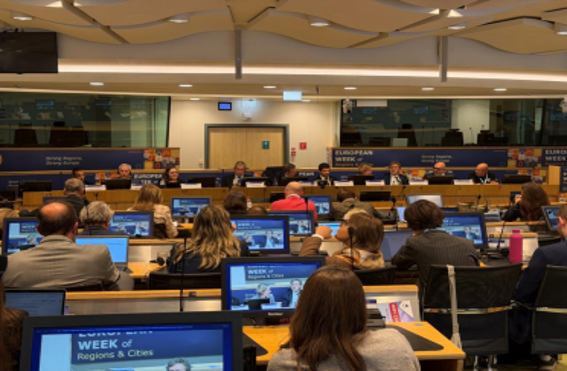
At the European Week of Regions and Cities, regional representatives called for greater investment, stronger cooperation and a more prominent role for local authorities in addressing the Mediterranean's climate challenges.
«More investments, more accessible financial instruments and full recognition of the role of regions.» This is the recipe for tackling climate change in Mediterranean territories, as outlined during the debate Regions Advancing Climate Resilience: Towards the Implementation of the Pact for the Mediterranean and the Connected EU Macro-Regional Strategies, held at the European Week of Regions and Cities in Brussels.
Moderated by Davide Strangis, Secretary-General of the Conference of Peripheral Maritime Regions, and introduced by Roberto Occhiuto, President of the Calabria Region, the session explored how European cooperation can translate climate objectives into concrete action.
Is it time to sound the alarm?
Presented by the European Commission in October 2025, the Pact for the Mediterranean aims to strengthen cooperation between the EU and its Southern Neighbourhood partners through initiatives ranging from economic development and clean energy to security and opportunities for young people.
Between 2021 and 2027, around €7 billion in EU investment has helped mobilise approximately €30 billion in funding. Will these resources be enough to keep pace with climate change?
Carlo Ciccioli, Member of the European Parliament, emphasised the need to reconcile human activity with nature without resorting to alarmist rhetoric. This position, however, raises a question: is it possible to balance gradual adaptation with the urgency of climate change, which is already affecting communities? A gradual approach cannot become a reason to postpone preventive action.
Irene Bonvissuto, from the European Commission’s Directorate-General for Climate Action, brought the focus back to the urgency of taking action. Climate impacts are accelerating across the Mediterranean, from coastal erosion and rising sea levels to extreme weather events. Resilience, she stressed, should not be considered a separate policy area, but a fundamental component of every investment. Preventing damage is essential to avoid the costs of emergencies.
Climate Resilience and the Right to Stay: the Mediterranean calls for European Action
Regional representatives brought the discussion back to the territories themselves. Marco Marsilio, President of the Abruzzo Region, described climate resilience as an economic and social issue, as well as an environmental one. The Mediterranean, he noted, is particularly exposed to climate risks, but can also become a European laboratory for testing new solutions.
Representatives from Andalusia and Croatia stressed the need to monitor climate risks and adopt integrated approaches, while Tiziano Consoli, representing the Marche Region, and Andrea Di Lucente, representing Molise, highlighted the importance of European coordination and accessible financial instruments.
Beyond infrastructure and investment, one question connects these contributions: who will remain in these territories, and under what conditions?
Roberto Occhiuto linked climate resilience to the right to stay, explaining how depopulation can undermine the everyday care of local territories. Where agricultural activities decline and communities disappear, territorial maintenance risks being neglected. Protecting places therefore means making them safe and liveable for their inhabitants.
The challenge for Europe is not simply to help regions withstand climate change, but to enable them to thrive despite it. For Mediterranean communities, resilience means safeguarding landscapes and local economies while ensuring, especially for young people, the opportunity to build their future in the place they have chosen to call home.
By Tiziana Albanese